Tuesday, September 27, 2011

Learn Genetics With Rigglefish

Rigglefish is an educational game designed to immerse middle school students in genetics and the process of scientific inquiry. Developed by VelScience, Rigglefish represents a collaborative effort between the University of Louisiana at Lafayette and Texas A&M and it was a gold medal winner at the 2011 Serious Play Conference.

You do have to request a
guest login to access the game and you should plan to spend at least an hour investigating the game world.

Attention: Sensory bling and a good story
Rigglefish grabs your attention from first with a bit of sensory allure in the form of a video that introduces a mystery. You’re Dr. Waters, sent to an underwater lab to breed a superior race of fish that can produce the lipid, Omega-X, a protectant against a deadly bioweapon. That’s the emotional hook that adds to your perceptual arousal, but that’s not all you'll need to do. There are other desired genetic traits you need to select for— like pressure insensitivity, spikelessness, and less wriggle—in order obtain a fish that’s easier to handle in the lab.


These multiple thinking challenges sustain your attention, along with the different tasks you need to complete as you:
  • Catch fish for breeding (use your trusty bathysphere!) 
  • Characterize them in the sample lab 
  • Breed them and then characterize their offspring

Relevance: Real (though virtual) lab work with lots of personal control

While playing Rigglefish, you’re focused on relevant real-world genetics tasks (characterizing, selecting, and breeding fish to obtain desired traits in their offspring) while your curiosity is stimulated to solve an imaginary problem. You have quite a bit of control over different aspects of the game, which enhances your sense that the game is personally meaningful. For example, you can choose which fish to catch and at what depth to catch them (which has an impact of fishes’ traits—there are more yellow fish at lower depths). The satisfying “glug glug” sound the bathysphere makes as it descends is also pretty cool!

Back at the lab, you can choose to characterize fish in sample tanks or make the riskier choice of going straight to the breeding tank. Although the game has some “rails,” you can make varied decisions along the way and get feedback as you breed fish with more or less desirable traits. The game also matches the motives of players by allowing you to choose whether you receive points or not. I did choose scoring to see what it was like when I explored the game.


Confidence building: Help when you want it
Although genetics can be a daunting subject, there’s lots of ways to build confidence in the game. The introductory video (which can be skipped) sets the stage for what you need to do to succeed in the game. Additionally, you can access a help icon at any point and pull the information you need (versus being forced to proceed linearly through a tutorial).

You also get feedback as you breed fish. Choose the right genotypes and you’ll get more yellow, less spiny fish, for example. Although the visual feedback you can obtain from “your” offspring is an extrinsic motivator, it’s intimately connected to the intrinsic satisfaction of mastering a genetics puzzle, so it’s actually a lot more satisfying than the points feedback, in my opinion.

From time to time you’ll get an audio message from someone on the surface who will comment on your progress and pose challenge questions, providing verbal reinforcement and further opportunities to consider your actions.These are unexpected and variable in timing, which tends to make them interesting and more satisfying.


While your fish sampling can be a matter of luck (not all genetic traits are readily connected to visual cues or phenotypes), your breeding outcomes can be stacked in your favor by your own skill in picking the right types of fish to breed, enhancing your feeling of satisfaction.

Conclusion
This is one of those rare educational games that’s engaging, fun, and manages to achieve some learning objectives along the way.I think this is because the learning objectives are integrated with the mechanics of the game (versus being tacked on as an afterthought). The only downside is that you only have access to the game for 24 hours at a time so give yourself a bit of continuous time to enjoy it. It’s worth it!


Smitten Kitchen—motivation to not order takeout (at least for one night)


I'm going to take things in a slightly different direction for a moment. The web-based motivational experience that I'd like to discuss is neither formally game-oriented, nor formally learning-oriented, but I think it serves as an interesting example of how motivational design, specifically related to Keller's ARCS model, can be carried out in diverse and unexpected settings.

As an amateur chef, I like to occasionally check out a number of different food and cooking media, but one that I return to more often than others is the Smitten Kitchen blog site.

While hungrily perusing one day, I was immediately struck by the success with which the site unintentionally uses ARCS principles to achieve reader motivation towards cooking the recipes portrayed.

One doesn't need to look far to see Attention jumping off the screen (if only it could jump off the screen and into my mouth...). What would a cooking blog be without mouth-watering images? They serve no other purpose than gaining an instant physiological reaction as the brain and stomach silently exclaim in chorus, "must eat pasta now!" In regard to rich visuals, Relevance rides in close on the heels of Attention. What could be more relevant to the act of dispensing recipe information than vividly displaying the end result? For my money, the only experience more motivating than seeing the final dish in all its glory would be someone shoving a spoon full into your mouth. Added attention to Relevance can be found in the miniature narrative that accompanies each recipe post. The author describes interesting anecdotes regarding her own personal experience with tomato sauce, the 4 Michelin Star chef whose recipe inspired this one, and the characteristics of what makes this dish excellent. If any of these topics pique the reader's interest (and since those attracted to food blogs are generally foodies, it is likely that at least one of these topics will), Relevance is immediately achieved.

Moving onto the third rail of cooking media: Confidence. It is a hefty order to instill any average home cook that might stumble upon this blog that the dish he/she produces will resemble in appearance or flavor that which is presented on the site. This hurdle is generally tackled with some finesse but the Smitten Kitchen author due to several factors. First: the recipes chosen aren't so fail safe that one could microwave three ingredients and call it a day, but they are usually minimalist in terms of ingredients and fundamental skills required. This helps greatly in managing cognitive load, which will inherently instill confidence. Second: notice in the pasta image at right that the text explicitly states that the dish is so good because of its simplicity. The continual emphasis on simplicity will reinforce confidence that the task will not prove overwhelming when the moment of performance arrives.

Satisfaction is a component less easily nailed down in a context such as this, but due to the impressive success of the other three components, this point should prove relatively moot.

I myself was inspired to make this naked tomato sauce dish as a result of this beacon of motivational success. It was as delicious as ARCS motivated me to believe it would be.


Simplifying a Complex Subject: The 2008 Credit Crisis

One of my favorite movie quotes is from the movie Philadelphia, in which the lawyer played by Denzel Washington tells the witness, "Now, explain it to me like I'm a four-year-old." I’ve felt that way whenever I’ve tried to make sense of what happened to cause the financial crisis of the late 2000’s. The topic is so complicated and whenever I’ve tried to learn more about it, the magazine articles or talking-head discussions on TV just haven’t held my attention. Recently, though, I discovered an 11-minute animated video called the The Crisis of Credit Visualized.


The video was created by Jonathan Jarvis and proceeded to go viral on YouTube. In this entertaining and informative video, Jonathan explains in a simple, concise manner how the actions of mortgage brokers, banks, and investors contributed to the credit crisis, a key component of the financial meltdown. Although a 4-year old would not be able to understand the content, this adult certainly did. On the other hand, the 4-year old would find the animations and sounds as fascinating as I did.

What gained and kept my attention throughout the entire video was the effective use of simple graphics, which are cleverly animated in perfect timing to the voice narration.
The storytelling is excellent; the story is scripted well from start to finish. The video is relevant for anyone who just wants a quick synopsis of the crisis without being overloaded with superfluous details. For the first time, I am able to understand the meaning of terms such as collateralized debt options (CDOs), hedge funds, and credit swap defaults, and how things fell apart when subprime mortgage holders defaulted on their debts. I feel confident now that I could contribute something meaningful to a discussion about the topic.

From a learner’s standpoint, I am satisfied with the quality and quantity of the information I learned from viewing the video. From the standpoint of an instructional designer, I admired how the author designed the video, and it gave me ideas that I can put into practice. From either standpoint, it was a worthwhile investment of time.

Monday, September 26, 2011

Evoke


Evoke is an interesting social project that has been gamified to get people thinking, sharing, collaborating and acting to solve real world problems.

Each 'game' has10 quests where users are sent a mission. Attention is abundant in this game. Users are given 'missions' in the form of illustrated stories that come alive in the eyes of the user. Should they choose to accept the mission, then the players will have 3 objectives:
1.) research as much as they can about the problem.
2.) act in some small way that aids the problem
3.) Imagine a possible solution on a grand scale and write about it


Evidence of accomplishing each objective of the mission is submitted in the form of a blog post, photo or video.

Other users rate skills by browsing the evidence and vote with with 'Evoke Powers' which is a badging system that rates specific strengths like resourcefulness, local insight, creativity, entrepreneurship, etc. Confidence is gained by users rating your evidence and giving you a skills badge. There is no negative rating. Completing the objectives and missions earns you credit toward winning, but all of this adds up to rewards and levels of membership that gain you the possible opportunity to get online mentorships, travel to the Evoke conference or money for a social venture. Though there are some extrinsic rewards, satisfaction is intrinsic in that users have been given the oppotunity to feel like they've made a difference in a real world problem. This game is highly relevant to those who wish to be a social activist or just make a small difference, as it gives players the opportunity to solve problems on a small scale or large scale.

Playing for a Cause

This is far from being a new and hip site, but my students LOVE to play on it. Freerice.comallows students to quiz their knowledge on vocabulary and other various subjects of their choosing. Instead of points, students earn grains of rice that are given to the UN's World Food Programme.

I thought it was entertaining that the first word that appeared on the vocabulary trivia was "fail" for a motivational blog post. Regardless of the irony, this game plays into the ARCS model fairly well.

Attention: It has an easy to use interface, bright colors, and pictures. The homepage takes you straight into a vocabulary quiz. It just begs to be answered!

Relevance: The site automatically directs you to the vocabulary page, but it can easily change to any subject the student or teacher is interested in playing. It is a test of your knowledge in a variety of academic subjects.


Confidence: The first question that appears is set at a low level (i.e. - "fail"). The vocabulary or questions are intended to increase in difficulty as you answer correctly. For incorrect answers, you continue on the same level and the incorrect word will repeat until a higher level is gained. The game is designed to build your confidence by achieving higher and higher skill levels.

Satisfaction: Along with achieving higher skill levels, you get to see the amount of rice you are earning to donate to third world countries. If you sign into an account, you can also save and track your scores to compare with other players.

I think the key to the success of this site is the simplicity of it. Students feel challenged just enough to continue playing and not feeling discouraged. They are reinforced by earning more rice and a higher level. They can chose a subject that meets their interest. What is there not to like about the educational aspects and the satisfaction in that students are spending their time solving the problems of the world a few grains of rice at a time?

Transition 3 Pointers: Duke University Style

This is a great site for all basketball coaching junkies. This is a sample of a video tutorial where they teach the learner the various skills needed to become a competitive basketball player. They offer tons of tools for learners. Here is the actual link to the site.

I don't know if it was intentional, but they seem to hit on many of the elements in ARCS. Each tutorial attempts to capture the Attention of learners by clearly labeling the skill that they will learn. They organize their content by allowing the learner to choose a specific problem they would like to solve. Obviously you must be a bit self motivated in basketball, but their organization builds curiosity to solve their specific problem a dig deeper into their site.

This learning experience is valuable and Relevant to the learner in two ways. The first is that they use expert advice (Duke University, High School Coaches, NBA Pros.) to train their learner. They use a universal basketball terminology that all learners can understand. Each tutorial focuses on solving a specific problem which makes it very valuable for the learner.

After viewing a few of their tutorials the learner feels very Confident they can either coach the skill themselves or execute it as a player. They chunk material into clear steps while providing feedback and demonstration to help the learner control their success.

One weakness this sight may have is the way they reinforce Satisfaction. The strategy they use to verbally reaffirm that they were taught what they were promised to learn going into the training.

Math Popper—And Why I’m Not Smarter Than A 5th Grader

As I’m not an educator—nor a gamer—I wasn’t initially sure how to go by researching a learning resource to analyze for this blog posting. Being a writer with a background in pumping out reports touching on a historical event or an extremely dry technical topic, my first inclination was to find an article about learning resources and motivation. While I’m not sure if this would violate the letter of the assignment, I do assuredly know this approach violates the spirit.


That said, I subsequently embarked on a mini-journey of digital discovery— scouring the Internet—being led by Google entries, like “learning resource,” “learning resource games,” “online games” and plethora of similar Google-always-knows-what-I-want-or-need inquiries. After quite a bit of searching, I realized I needed to sharpen the scope of my search and decided to look for math-related games.


It’s common knowledge that finding a good math teacher is difficult, so I asked myself the question: “Can I find a simple and user-friendly—yet still educationally-effective—math game online?” Fortunately, I found my answer: Math Popper on Funschool.kaboose.com.


Math Popper’s colorful banner graphic—with its Mario Brothers-esque carnie character—caught my eye first. Then, I knew I was in business when I read the line, “Pop the balloons with the correct answer before time runs out!” One reason I think I get along with kids so well—besides our shared love for swing sets, snacks and naps—is I have a VERY short attention span and I gravitate towards both simplicity and constant action. Back to the game—I clicked on the game’s “Play” icon and came to its page. Carnival music greeted my ears and the carnie waved his wand to invite me to play. Though, before I dived right in, I read the game’s description—which I have to say is in very small print, making it easy to confuse it for a legal disclaimer:


Add, subtract, and multiply numbers fast in Math Popper. This carnival math game is ideal for kids looking to perfect their addition and subtraction skills as well as learn multiplication tables. The objective of the game is to pop the balloons with the correct answer before time runs out.


Now having read the game’s succinct instructions, I was ready to get started popping balloons—and to see how far my horribly-deficient math skill could take me—and hit “GO!” Well, my gaming efforts were delayed by the “How to Play” screen that popped up, but after a quick few seconds of speed reading, I was ready to go again and hit “GO!” for a second time.


Once the game started, I was instantly hooked:


  • the synergy of the bright, friendly colors with the game’s simple layout/design virtually eliminated any extraneous cognitive load,
  • the game’s fast-moving dynamics and the sounds readily kept my addition,
  • the action of the balloons reminded me of the hot summer nights when, as a kid, I loved playing carnival games at the Ramona Country Fair,
  • and my desire to keep on pace—while also trying to rack up a high score—kept me actively engaged.


Alas, as many cunningly-precise business reports, profusely-reference academic papers and neurotically-detailed technical manuals I can pump out at a seemingly inhuman rate: my basic math skills—and especially my ability compute even the simplest equations with any rate of speed—are still deficient and I was only able to make it to Level 4 in the game.

I should say, my I-should-really-be-embarassed-because-I’m-not-smarter-than-a-5th-grader performance in no way limited my enjoyment of the game or biased my likelihood of referral.


Why?—you may ask.


Well, I’ll tell you: I enjoyed playing the game.


For me, in the few once-in-a-blue-moon times I do play a game—be it educational or otherwise—I’ll keep playing as long as I’m having fun. I know my last statement might stand as obvious fact for many of those reading this, but I think it’s important to remember when attempting to use games and/or simulations to teach children.


One of the main reasons I love spending time with kids is because their “mental computers” haven’t been corrupted yet and they aren’t—for the most part—soured to the world. This matters when designing educational games/simulations because as adults we have to remember kids aren’t drawn in by viral marketing elements. All of the tactics waged by marketers—status, access, power and stuff (Zichermann, 2011)—aren’t effective on children when applied to educational gaming.


Simply put, games/simulations for children need to be simple, easy-to-use and fun. Math Popper has all of these elements—and to further augment its appeal: it’s FREE!


Now, with my personal narrative detailing my personal experience complete, the following ARCS analysis concludes my report.


ARCS analysis (Keller, 2010):


A(ttenion)

Playing Math Popper grabbed my attention in an instant. The dynamics of the game and my experience playing it captured—and held—my interest, while concurrently stimulating my curiosity. Each new level of play refreshed my engagement and left me wonder what was to come next.


R(elevance)

A facet of my learning resource/online game search I didn’t touch in my personal narrative—but kept in my mind throughout —was the necessity of ensuring the game I chose contains design and play elements relevant to children. Knowing full well that attempting to explain to a school-grade child the imperative importance of learning basic arithmetic is most certainly an effort-in-vain, I wanted the game’s relevance to implicit/at the subconscious level.


C(onfidence)

Looking back, I realize I didn’t comment on the game’s ability to inspire confidence in players because I took for granted the fact I understood a correct answer—or pop of the balloon—results in the player succeeding and enabling a vehicle for success. As with relevance, the confidence Math Popper instills in learners is: covert, implied and implicit.


S(atisfaction)

Ah, now here’s a facet of player motivation made very explicit in the game. Pop the right balloon to answer the math equation and score a balloon on the scoreboard. Score five balloons and move onto the next level. This process reinforces player accomplishment internally—the mechanism case-dependent for each learner—and externally via a quantifiable score and auditory/visual reinforcement.

A Learning Resource with Motivation in Mind


One great resource I use on a daily basis for my students is a website called Typing Web.
As a high school computer applications teacher, I see students with a wide range of technical skill. Typing used to be its own elective class. Now it is blended into the basic skills computer curriculum. There are several characteristics that make this site motivating to a variety of students.


1.      Students see the connection between increasing their keyboarding skill and skills they feel are Relevant and meaningful to their lives outside of my class.  If they don’t have that internalized value before they walk in the 1st day of class, helping make that connection is not difficult.  Most students anticipate using a computer in some way in a future work of educational environment and are motivated to better their skill level.  All but a very few students are already have familiarity with keyboard function before 9th grade.

2.      I ask each student to create a personal account profile when they begin using Typing Web. Students are asked to set goals from the beginning.  For example, a student could state they are working toward certification or just improving their current skills. The lessons are stratified by levels of increasing difficulty. This helps me start more experienced students at higher levels so they don’t get bored.  The website gives feedback to learner about the progress toward their goal. Once students begin, they get feedback on their progress immediately. Students take small but challenging steps and are self-paced. There is plenty of virtual applause as the student improves and gains confidence.
3.      Typing Web. Utilizes a Leaderboard and connection to Facebook announcing who is typing now and who are the high scorers.  Learners are offered extrinsic rewards by reaching the hall of fame.  
   

4.      Typing Web has “Gamified” their tutorials as well, not that they invented the coupling of games with typing.  Within the website there are over a dozen different, fun, attention-grabbing games.  The games have increased interactivity, sound and graphics, which increase arousal.  Some are even add a little humor and kid-level silliness.  


5.      Learners experience variety and choice.  While progressing up the levels of experience and proficiency, learners are asked if they want to test the skills. They do this only when they feel ready. They can choose to repeat a section or go to a new challenge.   Learners are offered the ability to personalize their profile with a choice of “Skin”. Kids will select skins that reflect some part of their personality or what they think is cool. This personalization of colors and graphics helps to create a sense of personal control and a sense of ownership.

Sunday, September 25, 2011

Toastmaster's International

Now I know our focus is more on finding the ARCS model in gaming, but as I wandered through several internet sites in search of a good one to post about, I stumbled on the Toastmaster's International website. Lo and behold, on their front page, the following techniques were listed to make one's speech motivational:

  • Be enthusiastic. Enthusiasm is contagious! Before you present your ideas, think about the aspects of the subject that you find most interesting, and don’t be afraid to let that interest come through in your voice.
  • Use quotes, stories and anecdotes. Along with their obvious entertainment value, quotes and stories can lend authority to your topic and provide concrete examples that people can relate to.
  • Speak with confidence. Deliver your message loud and clear. Maintain eye contact with your listeners. Don’t mumble or slouch.
  • Say you and we, not I and me. Instead of telling people what you want them to do, present ways for them to work together to achieve their goals. Involve listeners in the success of the group.
  • Keep it simple. People aren’t motivated by what you say; they’re motivated by what they understand. The best way to ensure audience understanding is to break down complex ideas into simple components.
If you look at the five elements to making a speech motivational, you can see how each one fits into either attention, relevance, confidence (a bit loose but it works) and satisfaction.

When a speaker is enthusiastic during their speech, the audience's attention is maintained. Think back to when you heard both good and bad speeches. What was different in the speakers' enthusiasm? I know we can all relate this to a teacher of the past (you know the one I am talking about - that one who is brilliant in the books, but HORRIBLE at communicating such knowledge). If these brilliant types learned how to project enthusiasm into their lessons, the student would more than likely walk away with the lesson's objective.

Likewise, using quotes and stories to supplement the content being provided gives both attention, and relevance to the listener. Again, look at the teacher example. Which teacher in your past incorporated stories or motivational quotes or even jokes on occasion? How did that influence your participation in the class? How about a speaker you've heard?

The speaking with confidence element may sound like it just applies to the speaker, but think about it - if you have a confident speaker providing you with information, will you feel more confident about what you are hearing? What speakers that you've heard in the past who were less than confident? How did you feel about the material? Or were you too distracted feeling bad for the poor sap?

The using "we" element pertains to relevance and satisfaction. If the speaker can tie in how their information is applicable to the individual listener, odds are that the listener will retain motivation throughout the speech because in the end, we all are thinking: "What's in it for me?"

The final element listed above - Keep it simple - or KISS - speaks directly towards satisfaction. The speaker's goal is to get their message across to their audience in the most effective way - sometimes this means keeping it short and to the point. Think back to the bad speakers in your past - you know - the ones that ended up rambling on and on and on... What did you walk away with? A recent speaker I experienced who was a bit long winded left me with one thought: "Wow that was a long speech, I am glad its over so I can now go to the bathroom!".

After finding this site and pondering over how ARCS was incorporated, it makes me think about how many other aspects in our lives we unknowingly use these elements of ARCS. Think of athletic coaches, teachers (of course), managers, parents, etc...

Here is the link to the Toastmaster's site:

http://www.toastmasters.org/MainMenuCategories/FreeResources/QuestionsaboutLeadership/ConflictResolution/MotivationalSpeechTechniques.aspx

-Ann Bassolino

Wednesday, September 21, 2011

The Educational Value of Gaming

The following post and video is a great story about how students are engaged in Real World Problem Solving using video games. The class visited the company Valve and were each given a room to design for their video game. One of the biggest takeaways I got was how the students realized that collaboration is a true workplace skill. They were able to see how what their teachers were doing in the classroom is used in a workplace. Watch the video. I'm new to the video game world - so any information on Valve and ways for students to design basic video games would be great.


Original Blog Post:
The Educational Value of Gaming

Sunday, December 28, 2008

Bioterrorisk


Also produced by the Center for the Advancement of Distance Education (CADE) at the School of Public Health, University of Illinois at Chicago, this public health preparedness module has many educational and interactive features. It includes choice of roles (clinician, lab pro, or public health official) a case scenario, response options, risk evaluations, subject matter resources, and sample answers for the participant to compare their choices against. It also includes a sample phone call simulating the real-life playing out of the scenario and interaction with key partners.


The presentation is clean, authoritative, and accessible. It is in keeping with the traditional case scenario role plays used in medical education. I suppose it could be considered by some to be game-like based on the interactivity - especially those who are used to data filled Power Points. However, after taking 670, I would not classify it as an actual educational game. To cross the bridge to the gaming realm I would recommend adding components like competition and consequence. Does the patient live or die? How could your delays or missteps impact the outcome? How could you improve the outcome? Is your colleague/competitor closer than you are to solving the puzzle? (Okay, yes House could be an inspiration to my interpretation here!) Perhaps at scoring based on timeliness, communication, and response. The video technique in The POD Game could be used to help the player elicit accurate case histories. What is the motivation to learn the information other than professional responsibility?

The POD Game by CADE


During a public health disaster or emergency, it may be necessary to give large groups of people vaccines or medication to prevent or reduce illness. Public health preparedness efforts have focused on methods for accomplishing this rather daunting task. In the case of an anthrax attack, people in an entire region may need to receive medication within a very short time frame - 48 hours! How in the world can this be accomplished? One method planners have come up with is the POD, or Point of Dispensing site. These are essentially medication dispensing clinics where the goal is to get the medication distributed to the individuals who need it - FAST. Potentially millions of people may need to receive medication so this is not the time for face-to-face time with the nurse, pharmacist, or doctor!

The hundreds, or thousands, of staff and volunteers who would be called upon to work at PODS must focus on following the procedures to provide information, identifying those who are sick, and KEEPING THE FLOW MOVING. Since PODS are only to be used in disasters (the closest model may be a flu shot clinic - without the urgency) it is difficult to train the workers on what they must do and how they can do it during the chaos of an emergency. Also, this is a change for providers in that they are not doing in-depth histories or diagnosis. This online game was produced by Center for the Advancement of Distance Education, School of Public Health, University of Illinois at Chicago in 2006.

The POD game provides the scenario of an anthrax attack and the player is asked to select a role (medical screener, forms, or dispensing) and is then thrust into a simulated POD with the task to complete a certain number of a cases within 15 minutes and to help the POD reach its target flow of 1200 people per hour. There is a que of patients who present as video snippets and the player is given a choice of responses and actions they are tasked to complete. The player must select the appropriate response to avoid spending too much time with any one person and to refer them to special stations or call for assistance when needed. The time left and flow rate are constantly visible and feedback and corrections are instantly provided to reinforce the objectives. On top of selecting the right response to the individual, the player must also balance additional tasks such as making sure the supplies don't run out, requesting assistance from the appropriate party, and in the case of the dispenser - selecting the appropriate medication and calculating the dosage.

The POD game is a fun solution to the training needs for mass dispensing workers. Not only does it provide the possibly dry concepts and principles, it also provides experience in executing tasks in a difficult and unfamiliar setting. It also avoids the time and resource intensive half-day training that is the frequent alternative for many planners.

Wednesday, December 24, 2008

Alter Ego

I've had a fascination for those older computer games that I was able to play on my old Apple II. This is Alter Ego, originally created by Peter Favaro and published in 1986 for the Commodore-64, MS-DOS, Macintosh, and of course Apple II and has evolved thru various versions.

Alter Ego is a life simulator taking the user from birth to adulthood and beyond. It is a rather simple interface; mostly a black background with a white text and multiple-choice buttons.


There is a map that that is laid out pictorially with each image representing a facet of one's life i.e. faces represent the social aspect, brain represents the intellect, hourglass represents your age in the simulation, the graph represents your current stats, etc.


The simulation begins by answering a series of true and false questions.


The answers you choose will have a bearing on your character, personality, intelligence, health, and social aspects of your life. Clicking on the graph on the map will reveal your life status.


Overall, this is a fun and entertaining simulation whenever you want to explore the question, "What if...?"

http://www.theblackforge.net/alterego/alterego

Friday, December 19, 2008

Do you want to learn more about game engines?

While doing the e-game design, I learned quite a bit about the Unity game engine (and its price tag). I wondered if there was a web site out there that compared all of the game engines available. After browsing the web, I found this web site:

http://www.devmaster.net/engines/

If this course has inspired you to make your own e-games someday, you should check it out.

Tuesday, December 16, 2008

Business Simulation Games

The process of starting and running a small business is a complex task suitable for simulation by board or online games. The players seek a desired change of state (no business to profitable business) by following a specific set of tasks. The environment includes competition and risk, and is an area that is relevent and interesting to many individuals.


The Johnny Money Game is presented by The National Federation of Independent Business (NFIB) Young Entrepreneur Foundation to introduce 14-18 year olds to the day-to-day functions of an small business owner.

The simulation can be played individually, or as a class project with teacher instruction and facilitation. The game's length is a minimum of 45 minutes which covers a two-year period. Game hosts, Johnny and Jenny Money offer advice to players throughout the course of the game.

Players can choose between two retail businesses, and make decisions about securing funding, managing employees, and marketing. The game is well documented and guides teachers in the use of the game in the classroom or as an out-of-class assignment.

For younger teens, this game appears to be a high-quality introduction to the concepts of entrepreneurial business. I think the older teens might be put off by the Barbie Doll-like characters and cartoon illustrations. The Home Page/Registration page describes the game for "Young Entrepreneurs" in some circles, this means under 40 years of age. I think a little more information on the home page would be helpful. Otherwise, I was quite impressed by this site.

-Barbara Berkovich


Sunday, December 14, 2008

Augmented Reality


I thought Iʻd do a post about the technology of Augmented Reality.

Most people have never heard of it. Its actually pretty simple conceptually.

So we know about blue-screens and green screens and how they are used to switch out backgrounds in movies, right? Well Augmented Reality is similar in that its somehow modified by a computer, but rather than a green screen or blue screen being modified it is a pattern, usually of high contrast black and white. The pattern is unique and used to identify a particular object. Anyway what happens is that the computer (kinda) switches out the foreground object, basically covering an area marked by a pattern.

The computer reads a video camera hooked up to it and knowing all (or most) patterns are square attempts to figure out the rotation of the pattern in 3d space based on what it can recognize of its four points. In the computer the object is replaced by a 3d model. The final result is processed and sent to the screen or another visual device such as a tv.

So the result of the block of wood with a pattern you are shaking around looks like a piece of wood to you but look up at computer monitor and you are actually shaking a small village while the residents try their best to hold on.

Maybe thisʻd best describe it:
http://video.google.com/videoplay?docid=6523761027552517909

Theres a second thing thats being done with augmented reality. In that a 3d model is built that is exactly the same dimensions as a real object. When the pattern is referenced the 3d model can be used for collision detection so the virtual cartoon character can bump against the real physical object.

This is being used all over the place. Its being used as a reference and to train airplane mechanics. By wearing visual monitor glasses by looking at a pattern on an aircraft they can get an overview of the schematics for that section of the aircraft.

There are all sorts of educational applications this could be used for, just think of some, you can probably create a create a greate experience using augmented reality as a tool. Its a great tool to add excitement and motivation to any group of people using it.

The Plural Girls


This is actually going in the list of bad games that could be better. Itʻs called "The Plural Girls"
http://www.funbrain.com/plurals/index.html

I chose to pick a random educational game rather than a good educational game. It suffers from the many failures most educational games do: it fails to be a game but is called one.

You canʻt throw cartoon characters or a color changed and horizonally fliped one over some circles and call it a game. The objective in the game is to rescue some people from bubbles. Okay, its a simple enough game about plurality, we donʻt need a plot or anything. Marioʻs was just about saving the princess, not much of a plot, Qbert just needed to get to the top of a pyramid, why? Who cares! But it was fun. Educational games can be fun to, you just need to try a little harder. I know I shouldnʻt say it but what about some animated Technologies such as flash? You could get a much better experience.

Heres where Iʻm going to start my rant. Games are not forms. Games are not forms. Games are not forms. Games are not multiple choice questions. They are supposed to be fun. There are fifty ways you could take a concept such as teaching pronouns and go somewhere fun with it.

There are different levels of difficulty which is useful in a educational perspective you can chose between multiple choice, difficult multiple choice, fill in the blank, and tough fill in the blank.

What I really think the issue is that companies or institutions want to create some games in large quantities with little attention to quality.

What this game could use is some loving attention to story, pacing, and a purpose. You could add suspense and a sense of urgency by adding a timer, not just a timer but a timer linked to something happening. Add some cheering, some audio. Children that donʻt know plurality donʻt know how these things sound. As a child would you pronounce cacti, the plural of cactus as cack-tee or cack-tie. Youʻre educating them where you could just because it doesnʻt fit into the narrow objectives youʻve set. It is easy to play an audio file after they answer.

In my opinion educational experiences should also be linked together in a cohesive manner either through a world or a story. Rarely are you educating someone on a singular topic but a series of related topics. You need to immerse the student in a fun educational experience for it to hold and give them the motivation to continue playing. The Plural Girls game could be part of a larger story that children could progress through (or they could start with that one) but that also would give children an incentive to continue playing through curiosity.

Motivation and imersion is everything; the same is the case with casual games, the only difference is you must immerse them quicker and faster. You donʻt need a story, but you need to start them having fun right away. You can and should use as many tools as possible to immerse them, animation, music, gameplay, story, anything. But do it quickly, and donʻt be lazy. Because if you donʻt do a good job noone will play it. So its worthless.

Donʻt give them a form. A form is not a game.

fin.

kb

Wednesday, December 10, 2008

Ayity: The Cost of Life


Never have I played a game where I felt so heartbroken and exposed when it was all over.  Ayity (Creole for Haiti) puts you in control of a family of five living in the slums of Haiti.  The game is about work, living, survival, health, and happiness.  You, are in complete control of all of these elements.  As the game begins, you are faced with a decision.  Do you strive to be happy, healthy, educated, or wealthy? I decided to go down the path of happiness.  The landscape is defined by several physical elements:  The family farm, the family living quarters, a hospital and a school.  The scope of the game is 4 years, broken down by seasonal weather in haiti: Hurricane Season, Dry Season, etc...As the season come and go, you witness the implications of your actions. You ultimately get to decide which individual does what.  Do the kids go to school? Do the parents go to work? Does the oldest son work?  Does the entire family work?  Where do they work?  In the family farm? As rum distillers at a factory?  As the season progresses you get to see first hand exactly how much goud is made, how much is lost, who gets sick, who gets happier or depressed. 

I had a goal to achieve.  I wanted this Haitian family to be happy.  What I found was the exact opposite.  Under every circumstance, I found that the family was losing happiness, getting sick from the weather and from work, and ultimately losing money for hospital visits and school tuition.  Every season I tried to make it better, but it only got much worse.  The family was evicted from their living space, the family never made ends meat; in fact they stayed in the negative the entire 4 years, the children died, and the family suffered.  Ayity presents a harsh Haitian reality.  The season are harsh and unforgiving.  Individuals die, suffer, and are inextricably tied to eternal impoverishment.  

Overall, I give my highest ranking to Ayity.  Never have I been so affected by a game before.  


The Vynil Game


It is a simulation about the PVC Industry and its sustainable development


The idea of this game is to represent in a very fun way the efforts that the European Industry is making to ensure the sustainability of its production, processes and applications of PVC.

In terms of game design, I found it a bit confusing. I think the instructions on how to play are inadequate. I played the easy level and I had to play it four times in order to get an idea of the logic behind it.

The content and the development of the simulation are very attractive. The background information is good and the game layout is eye catching, however the complex interaction of variables whose behavior is not made explicit can demotivate. Importantly, I really did not feel I was actually learning the content i.e. how to make a PVC industry profitable but green at the same time. I felt I performed actions almost unconciously, which sometimes had positive results, but other times negative, in other words, I did not receive feedback of how my actions improved or made worse my situation within the simulatio.

To conclude, the game is obviously a business simulation game. In order to make decision making more strategic and satisfying, the player needs to understand better what the stakes are. For students who are not business orientated, we need some pre coaching on what makes a business and a sustainable one profitable.

Tuesday, December 09, 2008

The Top 10 Most Influential Educational Video Games from the 1980s

I came across this post from the Educational Games Research blog and thought it would be fitting to share.


Oregon Trail, Where in the World is Carmen Sandiego, and one of my personal favorites, Number Munchers, all made the list. Sure, the graphics may not have been the best, but looking back the educational value was priceless. Carmen Sandiego took us on whirlwind trips around the globe, SimCity taught us how taxes go to pay for new roads, and the Oregon Trail made us all aware of the importance of axels and the dangers of amoebic dysentery.

My childhood just wouldn't have been the same without these. Does anyone know what the popular elementary school educational computer games are these days?

The list sans commentary for the lazy:

  1. The Oregon Trail

  2. Where in the World is Carmen Sandiego?

  3. SimCity

  4. Reader Rabbit

  5. Math Blaster

  6. Mavis Beacon Teaches Typing

  7. Lemonade Stand

  8. Number Munchers

  9. Zork

  10. Windows Solitaire

The Piss Screen: Stop Drunk Driving

I stumbled across this interesting website that discusses games, simulations, and virtual worlds used for public health applications, sponsored by the Center for the Advancement of Distance Education (CADE).

http://www.publichealthgames.com/wp/?cat=4. Anyway, it has a ton of interesting, educational games that you can play or use for training.

One game I found particularly interesting is being place in urinals all over Frankfort, Germany. In an effort to curb drunk driving, and encourage taxi use, gaming devices ihave been installed in mens restrooms to get men to test their reflexes and remind them of the impact of drunk driving.

Basically, how it works is when a person begins to urinate, the game automatically starts, the player could then control the car WHILE they are tinkling. For example, if they wanted the car to go right, they simply peed to the right. (and visa versa).

The overall design of the driving game is a lot like the game Need for Speed, which requires a quick response time. Obviously the more drunk you are, the slower your response, reinforcing the effects of alcohol to the gamer. The game ultimately culminates in a shocking crash-sequence, leaving the viewer with little doubt as to the repercussions of driving while drunk.

If you want to watch a video of how the game works or see the game played, visit here. I do not recommend trying this at home. http://www.piss-screen.com/

Global Conflict and Investigtive Reporting

I found this site to be very interesting. The overview game a brief introduction of a land that is corrupt and dangerous. The game is suppose to teach high school students how to write investigative stories that portray the true events of the situation while exposing them to a different culture and global conflict. The game is a 3D role-playing game used to teach players different situations occurring in Latin America.The game is divided into five operations so players can choose the most relevant topics and make the game applicable to them. The interesting part about the game is it is based on true stories from teachers,students and subject matter experts who have experienced these situations. The game not only teaches students about global conflict in Latin America, but it includes geography, history, and current events. Here is the web site http://www.globalconflicts.eu/gcla/teaching.php . The sample picture would not load for some reason, but check out the web site for more information.

Sunday, December 07, 2008

The Defense of Hidgeon:The Plague Years

The Defense of Hidgeon is a web-based board game developed to teach research skills to incoming students at the University of Michigan. It is profiled in the article "The Effectiveness of a Web-based Board Game for Teaching Undergraduate Students Information Literacy Concepts and Skill," in D-Lib magazine.

The article discusses the effectiveness of the University of Michigan program to teach undergraduates basic information literacy skills using an web based board game, the Defense of Hidgeon. The research team tested a class of students to play the game, with monetary rewards and interviewed them to determine their experiences, ending with 3 suggestions for improvement.
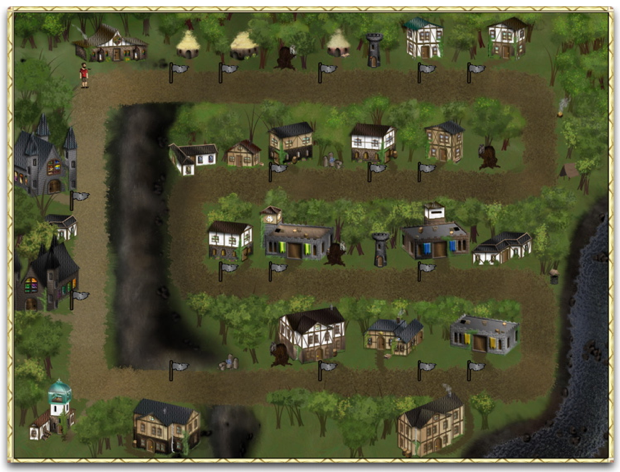
The Defense of Hidgeon Game Board

Incoming students need to know how to conduct research in today's information rich environment. While many may be familiar with online search methods, many perform poorly when faced with the prospect of researching scholarly journals and evaluating sources of information.

In this context, the prototype team developed a game would teach incoming students these concepts. The game uses a general to specific model of research. Players imagine themselves in the 14th century at the height of the Black Plague. Students play on teams navigating around the kingdom researching a solution to the crisis. Students are rewarded for being the richest, fastest, and most efficient team of researchers.

29 students test played the game, and identified several areas for improvement. For example, players could end up in "The Hospital" on several tasks, and due to design limitations, it would often take quite an effort to get out. The bug impeded flow for the players and many were frustrated.

Likewise, the team monitored the players for patterns of activity with the intent to judge the effectiveness of their application. Their data revealed some limitations of The Defense of Hidgeon and led to the following generalizations regarding game design:

1. Game Play That Counts toward Students' Grades in the Course - students need to see the correlation between participation and results
2. Game Play That Gives Players Mastery Over One Key Concept at a Time - students need to focus one message and have all game elements reinforce it.
3. A Payoff for Leaving the Computer Behind - there must be compelling reasons to motivate students to leave the "game world" to do tasks in the physical world.

The authors maintain that any game not acknowledging these factors will be ineffective.

Nobel Prize Trade Game

How do you explain Nobel Prize winning work? How about with a simulation style game! The good folks at NobelPrize.org have done just that, as part of their Education Games series, previously featured on this blog. This post will focus on the economic game, called Trade, which is modeled upon the Heckscher-Ohlin theory of goods and services. The into screen invites the player to read up on the theory itself, which being a good gamer I ignored (to my peril, as I was to discover).
The game starts with the player choosing an island to start on, with varying levels of capital and labor:
An then moves on to the usual player configuration features, which inextricably seem to channel a graphic sense perhaps best described as Art Clokey meets Kenny Scharf:


However, after some cajoling I was able to get an avatar that at least resembled a human:
Then the game begins, with very little instruction (should have read that intro)! The player is taken to a somewhat confusing main screen, but with only 3 buttons to choose from on the video, I clicked on the first to start production. After making cell phones, I am prompted to trade with my partner.

I do so and get a message whether or not the citizens of my land think prosperity has increased. This play continues for three rounds, and then ends abruptly, displaying the score and what the optimum score should be using t
he Heckscher-Ohlin theory. Needless to say, I would not make a good island economic czar.
Which brings me to the biggest complaint of the game - the design is confusing, especially if you are tempted to jump right in before reading the theory. There are too many little details on the main page that do nothing except serve as distractions for your mouse. I wish there was a bit more guidance - you are told to maximize prosperity, but never how to do this. I guess if someone were already introduced to the theory this would be a good little sandbox simulation. But if others' experiences were like mine, I would think that they may leave more frustrated than educated.